Dust storms are a fact of life in Arizona, especially during monsoon season. In the Phoenix area, powerful haboobs can develop quickly, reducing visibility from several miles to almost zero in a matter of seconds. These conditions have contributed to serious multi-vehicle crashes on major roadways, including I-10 and I-8.
Knowing what to do in a dust storm while driving can protect you, your passengers, and everyone else on the road. At Shapiro Law Team, we’ve helped victims of serious Arizona car accidents earn the compensation they deserve. Understanding the proper safety steps before a storm hits can help reduce your risk and may also affect how fault is determined if an accident occurs.
Arizona’s Official Dust Storm Driving Protocol: Pull Aside, Stay Alive
The best thing to do in a dust storm while driving is to follow Arizona’s official “Pull Aside, Stay Alive” protocol. Pull completely off the roadway, turn off your lights, set your parking brake, and remain inside your vehicle until visibility returns.
The Arizona Department of Transportation (ADOT) created the “Pull Aside, Stay Alive” campaign in response to multiple fatal dust storm crashes across the state. The campaign provides clear instructions for drivers who encounter severe dust storms and has become the standard safety guidance throughout Arizona.
The campaign gained additional attention after major dust storm pileups on Arizona highways, including a deadly crash near Picacho Peak that involved multiple vehicles and numerous injuries. These tragedies reinforced the importance of taking dust storms seriously and avoiding the temptation to drive through them.
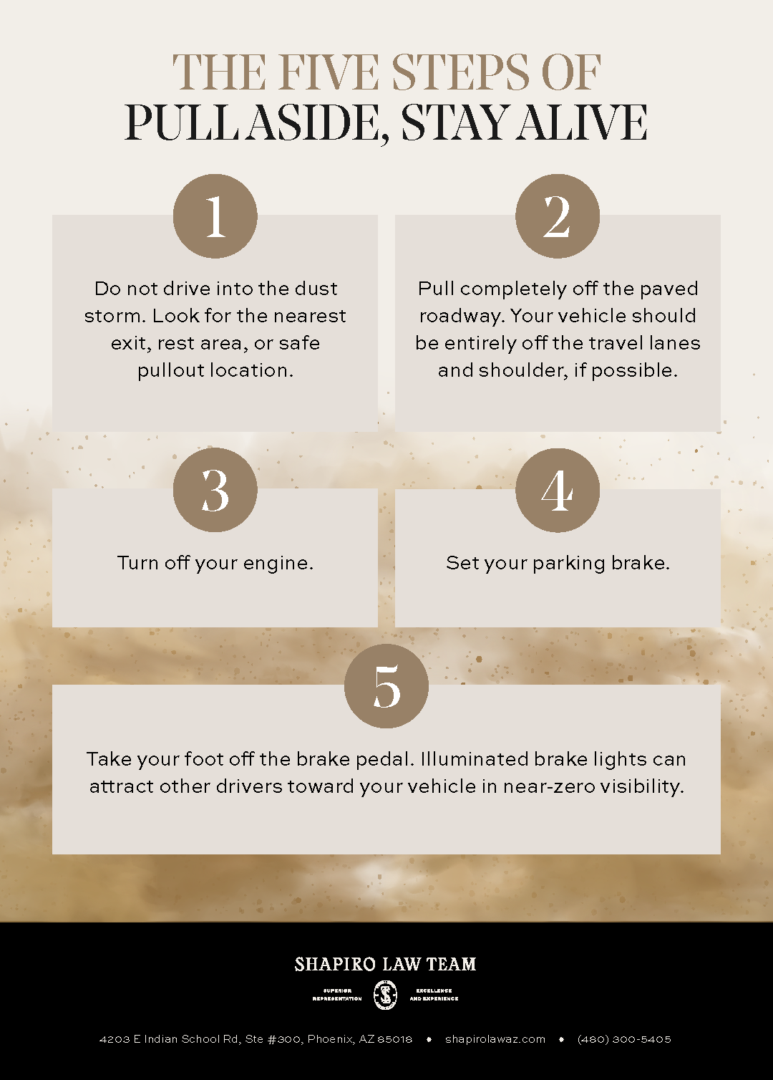
The Five Steps of Pull Aside, Stay Alive
- Do not drive into the dust storm. Look for the nearest exit, rest area, or safe pullout location.
- Pull completely off the paved roadway. Your vehicle should be entirely off the travel lanes and shoulder, if possible.
- Turn off your engine.
- Set your parking brake.
- Take your foot off the brake pedal. Illuminated brake lights can attract other drivers toward your vehicle in near-zero visibility.
What to Do If You Can’t Pull Off in Time
Sometimes a dust storm develops so quickly that reaching a safe pullout becomes difficult. If this happens, reduce your speed gradually and avoid sudden braking. While you are still moving, use your hazard lights to alert other drivers. Continue looking for the nearest safe place to exit the roadway.
Once safely parked off the road, follow the Pull Aside, Stay Alive steps and turn off your lights.
Why Turning Off Your Lights Feels Counterintuitive but Is Critical
Many drivers assume that leaving their lights on makes them easier to see. During a severe dust storm, the opposite can happen. Drivers caught in near-zero visibility often follow taillights, believing the vehicle ahead is still moving. If your vehicle is parked with lights on, another driver may unknowingly steer directly toward you.
Step-by-Step: What to Do in a Dust Storm While Driving
When a dust storm appears ahead, every second counts. Following the right steps before visibility disappears can help you avoid a serious crash and keep you safe until conditions improve.
Before the Storm Hits — Recognizing the Warning Signs
A haboob often appears as a massive brown wall stretching across the horizon. These storms can rise thousands of feet into the air and move rapidly across open desert areas.
Before traveling during Arizona’s monsoon season, check road conditions using AZ511 or local weather alerts. If you spot a dust storm in the distance, act immediately. Waiting even a few minutes can prevent you from safely getting off the road.
During the Storm — Stopping Safely
If visibility begins to disappear, focus on safely exiting the roadway. Once parked, remain inside your vehicle with your seatbelt fastened. Don’t leave your vehicle to seek shelter elsewhere. Flying debris, poor visibility, and nearby traffic can create additional hazards outside your vehicle.
After the Storm — Re-Entering Traffic Safely
Don’t rush back onto the roadway as soon as visibility starts improving. Dust storms often arrive in waves, and a second wall of dust can follow shortly after the first.
Wait until conditions have fully cleared before restarting your vehicle. Turn your lights back on before entering traffic. Watch for debris, sand, gravel, and other hazards that may have accumulated on the roads.
Liability and Fault After a Dust Storm Car Accident in Arizona
Many drivers assume that weather alone is responsible for dust storm crashes. While the weather plays a major role, Arizona law still examines individual drivers’ actions.
Because Arizona is a fault-based state, drivers can be held responsible if their actions contribute to an accident. Dust storms don’t automatically excuse negligent behavior.
Arizona also follows a pure comparative fault system under A.R.S. § 12-2505. This means multiple drivers can share responsibility for the same crash. A driver’s compensation may be reduced based on their percentage of fault, but recovery may still be possible even if they were partially responsible.
How Negligence Is Determined in Zero-Visibility Conditions
In dust storm accidents, insurance companies and courts often evaluate whether a driver acted reasonably under the circumstances.
Negligence can depend on:
- Whether the driver recognized the approaching dust storm
- Whether they reduced speed appropriately
- Whether they followed Pull Aside, Stay Alive guidance
- Whether they pulled completely off the roadway
- Whether they left their lights on after stopping
- Whether they exited their vehicle during dangerous conditions
Failing to follow safety guidance doesn’t automatically establish fault. However, it can serve as evidence that a driver failed to exercise reasonable care.
What If Road Conditions Were the Primary Cause?
Generally, agencies such as ADOT aren’t automatically liable simply because a dust storm occurred. However, certain roadway maintenance or warning-sign issues may require closer legal evaluation.
If flying debris from another vehicle struck your car, different liability considerations may apply depending on the circumstances.
If you were injured in a dust storm accident in Arizona, speaking with an experienced Phoenix car accident lawyer can help you understand your rights.
Common Mistakes Drivers Make During Dust Storms That Cause Accidents
Several dangerous mistakes repeatedly contribute to dust storm crashes, including:
- Stopping in a travel lane or on the fog line instead of fully exiting the roadway
- Leaving headlights, taillights, or brake lights on after stopping
- Attempting to drive through near-zero visibility conditions
- Exiting the vehicle during the storm
- Following other vehicles too closely
- Returning to the roadway before visibility fully improves
Avoiding these mistakes can significantly reduce your risk of being involved in a serious collision.
When the Dust Settles, Know Your Rights
Dust storms can turn a routine drive into a dangerous situation in seconds. By following Arizona’s Pull Aside, Stay Alive protocol, you can better protect yourself both on the road and after an accident.
If you were injured in a dust storm accident, Shapiro Law Team is here to help. Our Arizona car accident attorneys will evaluate your case during a free consultation and help you pursue the compensation you deserve while you focus on recovery.
FAQs — Dust Storm Driving Safety and Accident Liability in Arizona
Should I turn my hazard lights on in a dust storm?
Turn on the hazard lights while you are still moving to warn other drivers. Once you have pulled completely off the road and stopped, turn off your lights so other drivers don’t follow your lights off the road into your parked vehicle.
Is it legal to stop on the highway shoulder during a dust storm in Arizona?
Yes. Pulling off the roadway is not only legal, but it’s the state-recommended action under ADOT’s Pull Aside, Stay Alive campaign. Stopping on the travel lane, however, violates Arizona traffic law and creates liability if your vehicle is struck.
Who is at fault in a dust storm car accident in Arizona?
Arizona uses pure comparative fault (A.R.S. § 12-2505), so fault is allocated based on each driver’s actions. A driver who failed to pull off or left lights on while stopped can be held partially or fully liable regardless of weather conditions.
How long do I have to file a claim after a dust storm accident in Arizona?
Arizona’s statute of limitations for personal injury claims is generally two years from the date of the accident under A.R.S. § 12-542. Consulting an attorney quickly preserves your ability to document evidence and meet filing deadlines.
What is a haboob, and how is it different from a regular dust storm?
A haboob is a specific type of intense dust storm triggered by outflow winds from a collapsing thunderstorm. In Phoenix, haboobs can rise to thousands of feet and move rapidly across the desert, reducing visibility to near zero in less than a minute. Their speed, size, and sudden onset make them significantly more dangerous than ordinary blowing dust.