Arizona recorded 121,107 motor vehicle crashes and 1,228 traffic deaths in 2024, according to the Arizona Department of Transportation. In Phoenix, busy surface streets bring together heavy traffic, frequent turns, pedestrians, cyclists, and multiple lanes of vehicles.
Shapiro Law Team represents people injured in Phoenix car accidents and helps clients understand disputed fault, insurance claims, and their options after a serious collision. To identify some of the most dangerous intersections in Phoenix, this guide uses City of Phoenix traffic-safety analyses that consider crash frequency, severity, and type.
Why Phoenix Intersections Are So Dangerous
Several characteristics of Phoenix streets can increase the risk of a serious intersection accident.
Busy arterial roads: Major streets such as Indian School Road and McDowell Road carry heavy traffic through residential and commercial areas. Multiple lanes and frequent turning movements create more opportunities for conflicts.
Pedestrians and cyclists: In Dangerous by Design 2026, Phoenix-Mesa-Chandler ranked 22nd among U.S. metropolitan areas for pedestrian danger, with a Pedestrian Danger Index of 3.11.
Distraction and visibility: Phones, other distractions, and Phoenix’s intense sun can make it harder to notice changing signals, pedestrians, or stopped traffic in time.
The Role of High-Speed Arterials
Phoenix’s major arterial streets move large volumes of traffic through busy urban areas. Higher approach speeds can increase stopping distance and contribute to more severe collisions when a driver misses a signal, fails to yield, or cannot stop in time.
How Arizona’s At-Fault Insurance System Affects Crash Victims
Arizona is an at-fault state, meaning the person responsible for causing a crash may be financially responsible for resulting damages. At an intersection, disputes over who had the right-of-way or ran a red light can make establishing fault more complicated.
View: Most Dangerous Intersections in Phoenix
The Most Dangerous Intersections in Phoenix, AZ
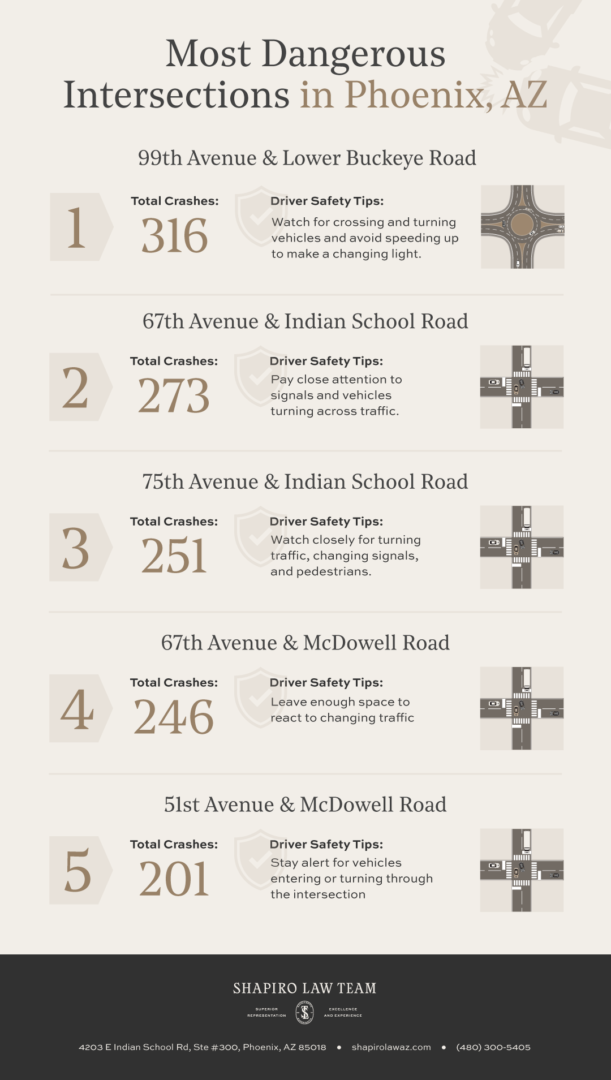
A City of Phoenix safety analysis ranked intersections using crash frequency, severity, and type to calculate an Intersection Safety Score. The figures below come from that analysis and should not be read as current-year crash totals.
75th Avenue & Indian School Road
This intersection ranked first in the Phoenix safety analysis, with 251 crashes in the dataset. It received the highest Intersection Safety Score among the Phoenix locations studied. Drivers should watch closely for turning traffic, changing signals, and pedestrians.
67th Avenue & Indian School Road
67th Avenue and Indian School is one of the most dangerous intersections in Phoenix, ranking second in the city’s analysis. The dataset included 273 crashes, and the intersection received one of the highest Intersection Safety Scores. Drivers should pay close attention to signals and vehicles turning across traffic.
67th Avenue & McDowell Road
This intersection ranked third, with 246 crashes recorded in the city’s dataset. Multiple lanes and frequent turning movements can create several points of conflict, so drivers should leave enough space to react to changing traffic.
99th Avenue & Lower Buckeye Road
The city recorded 316 crashes at this intersection, which ranked fourth based on its overall Intersection Safety Score. Drivers should watch for crossing and turning vehicles and avoid speeding up to make a changing light.
51st Avenue & McDowell Road
This location ranked fifth, with 201 crashes recorded in the analysis. Drivers should stay alert for vehicles entering or turning through the intersection and leave adequate following distance in heavier traffic.
The City analysis supports these five locations, so additional intersections such as 7th Avenue & McDowell Road, 35th Avenue & Camelback Road, or 19th Avenue & Dunlap Avenue have not been added without equivalent data support.
What to Do If You’re in a Crash at a Dangerous Phoenix Intersection
Intersection crashes can become complicated when drivers disagree about right-of-way or traffic signals.
- Call 911. Arizona law requires a driver involved in a crash resulting in injury or death to immediately notify the appropriate law enforcement agency under A.R.S. § 28-666.
- Avoid admitting fault. Give police accurate information, but do not guess about who caused the collision or make statements that could be misconstrued as an admission of fault.
- Document the intersection. If safe, photograph signals, signs, skid marks, sight-line obstructions, vehicle damage, and nearby businesses that may have surveillance cameras.
- Get the police report information. Ask for the report or incident number and instructions for obtaining the completed report.
- Seek medical attention. Some injuries are not immediately obvious. Symptoms associated with whiplash and concussion may become noticeable later.
- Consider speaking with an attorney. A Phoenix car accident attorney can investigate available evidence and explain how Arizona law may apply.
How Intersection Design Can Establish Liability
Road design, traffic signals, maintenance, or other conditions controlled by a government agency can sometimes become relevant when determining liability. Claims involving the City of Phoenix or another public entity have special legal requirements and potential defenses.
Under A.R.S. § 12-821.01, certain claims against Arizona public entities or employees generally require a notice of claim within 180 days after the claim accrues. This shorter deadline makes early investigation important when government involvement may be an issue.
Why Intersection Crashes Are Harder to Prove Than Rear-End Collisions
Intersection crashes often involve conflicting accounts about signal color, right-of-way, speed, and turning movements. Determining left-turn collision fault may require witness statements, surveillance footage, vehicle damage, or traffic-signal information in addition to the initial police investigation.
How Arizona’s Traffic Laws Apply at These Intersections
Several Arizona traffic laws may be relevant when determining what happened at an intersection:
Right-of-way: A.R.S. § 28-771 establishes right-of-way rules when vehicles approach or enter certain intersections.
Left turns: Under A.R.S. § 28-772, a driver turning left must yield to oncoming traffic that is within the intersection or close enough to create an immediate hazard.
Traffic signals: A.R.S. § 28-645 establishes how drivers and pedestrians must respond to traffic-control signals.
Pedestrian crossings: A.R.S. § 28-792 requires drivers to yield in certain crosswalk situations when traffic-control signals are not present or operating.
These laws are provided for general educational purposes. How they apply to a particular collision depends on the circumstances.
How Comparative Fault Works When Both Drivers Share Blame
Arizona follows a pure comparative fault system. Under A.R.S. § 12-2505, compensation generally decreases according to the injured person’s percentage of responsibility.
For example, if your damages total $100,000 but you are assigned 10% of the fault, your recovery could be reduced to $90,000.
What the Police Report Says — and What It Doesn’t
A police report can provide important information from the crash investigation, but it does not necessarily settle civil liability. Insurers and attorneys may also review surveillance footage, witness statements, traffic-signal information, vehicle damage, and other evidence when investigating an intersection collision.
Injured in a Phoenix Intersection Crash?
Knowing the most dangerous intersections in Phoenix can help you stay alert, but even careful drivers cannot prevent every crash. If another driver’s actions leave you injured, Shapiro Law Team can help you understand your options and pursue the compensation you deserve.
Our team provides compassionate guidance and Superior Representation for Phoenix car accident victims. Contact Shapiro Law Team to discuss your accident and next steps.